
Wine of the Week: Lovingston Cabernet Franc 2010

Oct 24

There has been a lot of discussion in the Virginia wine industry in the last year or so about whether we should continue to hang our hats on cabernet franc as our red grape strong suit, or instead shift to merlot or petit verdot.

Virginia cabernet franc decisively trounced a Loire Valley cabernet franc in the first Virginia Wine Summit on 10/2 when Barboursville cabernet franc 2008 was the clear favorite over a fine Chinon. But more to the point, if you look at the results of the 2012 Virginia Wine Governor’s Cup, it’s compelling that there were no gold medals for petit verdot, while in contrast there were 2 gold medals, a whopping 33 silver medals, and 22 bronze medals, or 57 medal winning wines altogether, by far and away more medals than any other grape or blend category.

Consistency says a lot about the terroir of a grape variety for a particular region, and these 55 award-winning Virginia cabernet francs came from four different vintages; 2007-2010. Combing this with the Barboursville 2008 caberent franc reserve trouncing the Chinon in the Virginia Wine Summit, it’s clear that we should be re-evaluating the track record of cabernet franc in Virginia.

In that vein, the Wine of the Week is the Lovingston Vineyards Monticello cabernet franc 2010. The color was dark garnet, followed by aromatics of dark plum and cherry. On the palate, wow; intensely fruity with mineral and black pepper notes on the nose. On the palate, the wine is bursting with black cherry and plum flavors, blending with fine, long, smooth tannins and electric acidity. Just reaching its prime, this wine will last another 8 years.

Finger Lakes Riesling: the Terroir Project at Fox Run, Part 2

Oct 19

Just about two months ago, I wrote here about the “Lake Dana Vineyard” series of rieslings released in spring by Fox Run Vineyards on west Seneca Lake in the Finger Lakes (NY).

While Fox Run winemaker Peter Bell is a well-known and respected riesling specialist, with both a reserve label and one third of the “Tierce” collaborative effort with fellow Seneca Lake winemakers Johannes Reinhard and Dave Whiting, he doesn’t rest on his laurels. Looking east to the Old World, while standing in the New World, he started digging into the geologic roots of the Fox Run Vineyard and discovered (under his feet) that its western boundary was the prehistoric shoreline of Lake Dana  (no connection with long-time Finger Lakes winemaker Dana Keeler).

As a press release from Fox Run states, Lake Dana was the ur-lake formed by retreating glaciers that superseded the present-day Seneca Lake, with a higher shoreline, and the soil is thick loam over lakeshore shale, “ideal for Riesling.”

There are three wines made in this Lake Dana series, named 10, 11 and 12, all from the excellent 2010 vintage.

The first wine, Riesling 10, was a dry riesling made in a New World technique that was described in a blog post here on August 21st.

The next two wines, Riesling 11 and 12, were both made with over 6% residual sugar (auslese range for Mosel rieslings), with 8% alcohol, but processed in different styles, which made an interesting contrast. Both rieslings were harvested on October 14, 2010 at 21.1 Brix and whole-cluster pressed, but the 11 was fermented with native yeast and “benevolent laissez-faire” with no modern intervention until the wine reached 8.5% alcohol when it was stopped, retaining 6.1% residual sugar (pH 3.0, acidity 8.5 g/L, 22 cases made).

My tasting notes on the Lake Dana Series Riesling 11 (2010):

Delicate and fragrant aromatics, classic Middle Mosel hallmarks of white flowers, slate, red apple and peach. Palate: ripe white/yellow peach flavors, definitely sweet but fruit still fresh,  spring-like and with balanced acidity; a long fresh fruity finish. I was instantly reminded of great Middle Mosel vineyards like Erdener Treppchen, Wehlener Sohnnenuhr or Graacher Himmelreich. Delicate and delicious now, but will benefit from longer aging (best in a decade).

The Riesling 12 was harvested on the same day from the same vineyard and the grapes were also whole cluster pressed, but the main processing difference was that this lot was inoculated with Epernay II commercial yeast, and the fermentation “was carefully managed using current new-world winemaking techniques” then stopped at 8% alcohol (with a slightly higher residual sugar than 11 at 6.4%; 74 cases made).

My tasting notes on the Lake Dana Series Riesling 12 (2010):

Much more closed  than #11 on the nose, but also delicate and fresh. Aromas of complex smoky minerality and green apple, much like a classic Saar riesling, not nearly as fragrant and forward as #11. On the palate, light, lively and fresh, but with finer, more racy acidity than #11 and less lushness in the fruit, although the finish seems sweeter.
This wine is reminiscent of an Ockfener Bockstein or Maximin Gruenhauser (Saar or Ruwer), and needs time to integrate. While those who like a sweet riesling might quaff this in a jiffy, the terroir elements need time to emerge, integrate with the acidity, and let the sweetness fade a bit, for it to reach its potential. It will be very rewarding with more time.

Assessment:

It’s great that Finger Lakes winemakers continue to experiment and push the envelope, whether it’s planting old German clones, making reserve bottlings or high-end dry rieslings like the Tierce collaboration or  sweet, traditional German style late harvest rieslings.

This terroir project of the Lake Dana Series at Fox Run is a new interpretation of riesling through the lens ofterroir,in this case finding the shoreline of an ancient lake with well-drained soils that provide superior sub-strates for the expression of site-specific terroir within the larger terroir of west Seneca Lake.

We are told in the winemaker notes that the source juice for all three rieslings was the same, and so we have the constant of the terroir and the fruit, then we see how winemaking choices of dry vs. sweet and native vs. cultured yeasts affect the final wine.

As I mentioned in the August post, the dry version made a clean and fresh wine, but I think that in dry processing, the whole cluster technique for riesling seems to strip all the fruit from the aroma and palate, unless you return to the wine a decade later, and how many people will do that…with a riesling? The Riesling 10 reminded me of the high-end dry rieslings from Washington State’s Columbia Valley, but a very austere and lean wine it was. I want more fruit in my riesling.

I was far more intrigued by these two low alcohol, auslese-style interpretations in rieslings 11 and 12. Part of this was that, controlling for residual sugar and alcohol, the only main variable being the yeast strain, the wines are surprisingly different, yet having far more recognizable riesling hallmarks than the uber-dry riesling 10.

I liked how both these rieslings took me right to Germany, specifically the Mosel-Saar-Ruwer river system, but how the first one was classically Middle Mosel while the second was more Upper Mosel or Saar-Ruwer like. Ripe juicy fruit versus racy citrus minerality, yet both with the same amount of hefty residual sugar.

I like them both and would like to see them age. These would be great food wines because of their delicacy and fruit/acid balance, but also because with lower alcohol you get more of the naked grape and more versatility; high alcohol rieslings lose a lot of grape aromatics and flavor because the flavor compounds are lost in the process of fermentation. The only trouble is, riesling 11 only produced 22 cases, while riesling 12 only made 74 cases.

If I were Fox Run management, I’d put half of this small production down to age, for trade education purposes and library releases, and plan to sell the rest to the wine club and key restaurants who can appreciate low alcohol, high residual sugar rieslings as fine food wines or connoisseur collectibles, and not dismiss them as only fit for “girly-men.”

VA Wines Beat France in “Judgment of Virginia” Blind Tasting At RR Smith Museum on 10/14

Oct 16

Following close on the heels of the landmark Virginia Wine Summit blind tasting on 10/2 where Virginia wines bested worldwide competition by a score of 5-3, the “Judgement of Virginia” blind tasting of seven pairs of Virginia wines and French wines at the RR Smith Art Museum in downtown Staunton on 10/14 also resulted in an upset victory for Virginia wines, which edged out French wines 4-3.

Two characteristics were noteworthy in the upset; the Virginia red wines beat all the French red wines, and also, the pinot noir and sparkling wine.

The event was coordinated by the Thomas Jefferson wine committee led by Scott D. Ballin, JD of Washington, D.C. who also maintains a residence in Staunton, with the aim of raising money for the RR Smith Center for History and Art in Staunton. Ballin said that he was really please and somewhat surprised at how well the reds did in the competition, especially the pinot noir. It suggests to him that  Jefferson’s cherished Burgundy can be grown and produced in the Old Dominion and he hoped to see more of it. He is already talking about a repeat performance of the event next year.

Judges included Virginia wine industry pioneer Gabrielle Rausse, his son Tim Rausse (also a winemaker), Ben Gilaberti, former wine columnist for the Washington Post and consultant to Calvert Woodley Wine in Northwest Washington; Daniel Mahdavian, Master of Ceremonies, beverage marketing maven, former hotelier and restaurant manager and early advocate of Virginia wines; Kyle Boatwright, formerly of the Staunton Grocery and currently with Country Vintner; Megan Headley, Charlottesville restaurateur and wine writer; and this writer.

Unusual for a wine judging, the event was performed in front of a live and paying audience. After fascinating reminiscences of the early hard days in the industry by Gabrielle Rausse and comments by other judges, Rausse was presented with an 18th century cartographer’s map of Italy by Scott Ballin for his contribution to the Virginia wine industry.

Also unusual for a wine judging, the reds were tasted first and ranked (on the 20-point scale), followed by the whites. The categories were: pinot noir, Right Bank Bordeaux-style red blends, Left Bank Bordeaux-style blends, viognier, chardonnay, pinot gris, and sparkling wine.

The competition results were:

2011 Ankida Ridge pinot noir (VA, Amherst Co.) over 2009 Louis Latour Volnay En Chevret Premier Cru

2008 Barboursville Octagon (60% merlot) VA, over 2009 Ch. Croix Figeac St. Emilion,

2008 Barren Ridge Meritage (VA, Shenandoah Valley) vs. 2006 Ch. Gloria St. Julien

2011 Keswick Signature Series Viognier (VA-Monticello) vs. 2008 E. Guigal Condrieu

2010 Jefferson Chardonnay Reserve vs. Domaine Delarche Pernand-Vergelesses

2011 Pollak Pinot Gris vs. 2009 Domaine Paul Blanck Pinot Gris

2008 Thibault-Jannison Cuvee D’Etat (VA) v. Jacques Lassaigne Les Vignes De Montgueux Extra Brut Blanc de Blancs

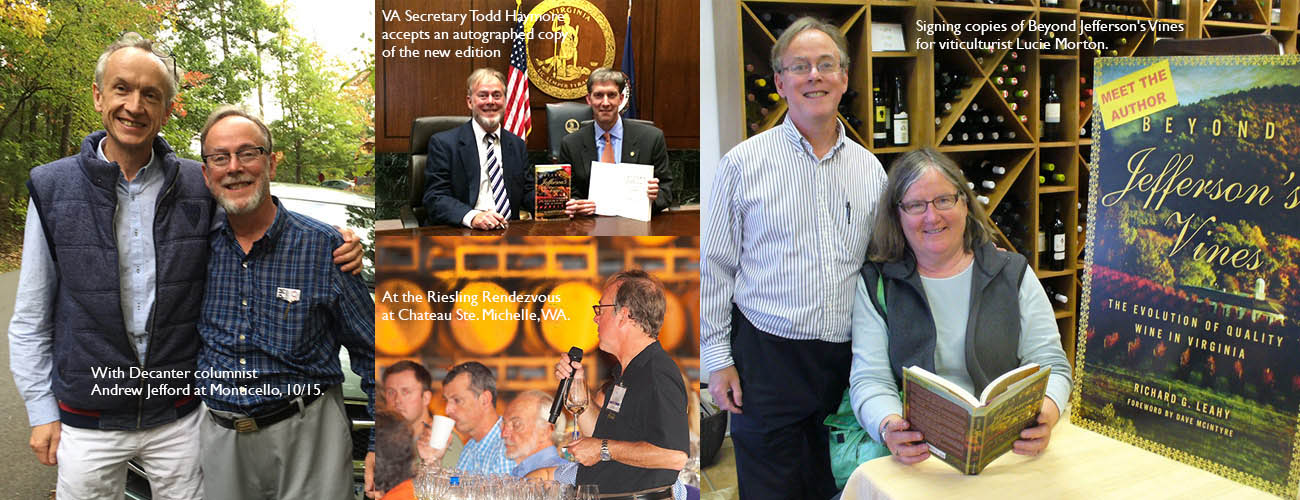
Following the tasting, wine country fiction writer Ellen Crosby was on hand to sign copies of her Virginia wine mysteries, and this author signed copies of Beyond Jefferson’s Vines.

This author was impressed by the thoughtfulness of the Wine Committee’s choices, and particularly impressed that not only did Virginia beat all the French reds, but also there was no contest in the pinot noir match nor the sparkling match.

It seems Virginia wines can not only compete on a world stage but beat the French, just like California wines did some 26 years ago. Maybe it’s time Virginia wines got some respect…even from the Californians?

Steven Spurrier, Renowned British Wine Critic, Praises Virginia as a “National Contender” in Wine

Oct 10

The keynote speaker at the first annual Virginia Wine Summit at the Richmond Marriott on October 2nd was Steven Spurrier, columnist for Decanter magazine and the man behind the watershed “Judgment of Paris” taste-off between California and French wines which established California overnight as a legitimate wine region when its wines won the tasting in 1976.

Spurrier’s presence at any wine event, particularly a blind tasting challenge, is news in itself. Stakes were high as the summit began with a “Breakfast of Champions” blind taste challenge featuring eight sets of two wines each, one being from Virginia and the other being from another region.

Virginia wines were chosen by Bartholomew Broadbent, son of leading British wine writer Michael Broadbent and a Richmond native, and head of Broadbent Selections, a wine distributor. Wines in the same variety or category were chosen by Jay Youmans, a Master of Wine and head of the Capital Wine School in Washington, D.C. Neither knew the other’s choices, and both were on the tasting panel along with Spurrier, who knew none of the wines.

Long-time followers of the Virginia wine industry were confident of a good showing, but not only did Virginia win the taste-off by an audience preference (by show of hands) by five to three, Spurrier himself preferred the Virginia wines by a margin of six to two, with the two remaining flights both being a tie vote.

In his keynote address, Spurrier addressed several aspects of Virginia wine:

  • comparing Virginia to other U.S. wine regions,
  • commenting on grapes and styles of wine,
  • Virginia wine in the media,
  • wine tourism.

He admitted that while “I probably know less about Virginia wine than most of you in this room,” he said that from his initial exposure to Virginia wines at the ground-breaking Virginia Wine Experience in London in 2007, he was been impressed, and that opinion was only reinforced during his several days as a guest of Governor and Mrs. McDonnell and at the “Breakfast of Champions” tasting.

“Compared to the other American states, Virginia is a national contender,” he declared, explaining that the cooler climate than the West Coast produces wines of brighter fresher character that are more food-friendly “and most importantly, call for a second glass.”

On grapes and styles, he noted that the largest planted variety, chardonnay, was dropping in acreage. Although he believes Virginia still produces good chardonnay, he noted that “we had a great interactive discussion on viognier for 45 minutes; you can’t do that for more than ten minutes with chardonnay.” On the reds, he noted that petit verdot was “a unique calling card for Virginia wine” and that cabernet franc “is world-class here,” while petit manseng and tannat “are interesting newcomers.”

Regarding the style of Virginia wines, Spurrier admonished that “It is very important in my view that Virginia wines continue to be recognizably Virginian, and avoid a ‘flashy’ international style.” When asked about how he has seen Virginia wine evolve since he first tasted it in 2007, he replied that he felt Virginia wines were “more clearly defined” in varietal character. While noting that stylistically Virginia wines are more European than West Coast, Spurrier noted that being in the New World gave Virginia the freedom to experiment; “Virginia is not derailed by the habits of the past.”

Addressing Virginia wine in the media, he noted that other British wine writers like Hugh Johnson and Andrew Jefford were impressed with Virginia wine at the 2007 Vinopolis tasting in London and articles began to appear at that time, but thanks to the efforts of the Governor, the Secretary and the Virginia Wine Board’s marketing efforts, Virginia wine continues to be placed in the spotlight where it needs to be for it to get the attention of the wine media, due to the competition for attention from so many wine regions.  Recalling the Vinopolis tasting, he said “We were amazed  at the cabernet francs and viogniers at the time, but today’s event is another important step” in establishing credibility for Virginia as a wine region.

Finally, Spurrier addressed wine tourism, and complimented state government for actively promoting Virginia wine, which would also encourage wine tourism, and contrasted this with the “Prohibitionist” legislation in France that prevents wine producers from doing more in advertising than merely showing the product. “Wine tourism is one of the few ‘win-win’ propositions in the industry,” he observed, adding that it adds a fourth “P” of “Place” to three  other “P”s of marketing which are Product, People and Position.

Spurrier will “wave the flag” for Virginia wine  in his December column of Decanter (which also has an online edition), due out in early November; stay tuned!

Here are Steven Spurrier’s scores and identities for the “Breakfast of Champions” comparative blind tasting:

1a – 16(Guigal Condrieu 2010, $39) /1b – 17 (Ducard Signature Viognier 2010-VA), $24).

2a – 16 (Bernard Baudry Les Grezeaux Chinon 2010, $23) /2b – 16+ (Barboursville Reserve Cabernet Franc 2009, $23).

3a – 16 Ch. du Tertre Margaux 2008, $39) /3b – 17+ (Potomac Point Heritage Reserve 2009, VA, $27).

4a – 16+ (Keswick Cabernet Sauvignon 2009 VA, $49) /4b – 16+ (Ch. Montelena, Cabernet Sauvignon, Napa Valley 2009, $37) TIE.

5a – 17 (Barboursville Nebbiolo Reserve 2008 VA, $32) /5b – 16 (Vietti Barolo Castiglione, $39).

6a – 17+ (Delfosse Petit Verdot 2008 VA, $18) /6b – 17 (Casale del Giglio Petit Verdot 2009, $18).

7a – 16.5 (Quinta do Crasto Touriga Nacional, $70) /7b – 16.5 (Barren Ridge Touriga VA, 2007 $18). TIE

8a – 15 (Cispin Cider, $8/4 bottle pack) /8b – 16 (Foggy Ridge Sweet Stayman cider VA, $15/750 ml).
“It seems I really liked the Virginians!” – Steven Spurrier

First Virginia Wine Summit: the “Judgment of Virginia” Affirms World-Class Nature of Top Virginia Wines

Oct 03

October 2nd, 2012: The first Virginia Wine Summit was held today at the Richmond Marriott. Brainchild of First Lady Maureen McDonnell and organized by the Virginia Wine Board Marketing Office, the event attracted a sold-out crowd of media, trade and consumers who tasted and talked about Virginia wine for some six hours.

Speaking as a professional organizer of wine conferences (www.easternwineryexposition.com), I felt this was not only a fine conference on Virginia wine, but one of the best conferences on ANY kind of wine I’ve attended.

The keynote speakers was Steven Spurrier, a renowned taster who is columnist for Decanter magazine and whose landmark “Judgment of Paris” tasting of top French vs. California wines in 1976 put California on the map as a world-class region when its chardonnays and cabernets beat out the French competition. He was characterized in the movie “Bottle Shock” about that event.

Other speakers included both First Lady Maureen McDonnell and Governor Bob McDonnell, Jean Case of Early Mountain Vineyards, sommeliers, Masters of Wine (Jay Youmans from the Capital Wine School in Washington, D.C.), Bartholomew Broadbent, distributor and fan with his father Michael Broadbent MW of Virginia wine; many top Virginia winemakers, Dave McIntyre, wine writer for the Washington Post, and many others.

I think most attendees would agree with me that the entire event would have been worthwhile merely for the benefit of the very first session, titled “Breakfast of Champions,” where eight types of wine, one each of Virginia and a non-Virginia wine, were tasted against each other. The audience gave its preference in a raising of hands, and the panel (Bartholomew Broadbent, Steven Spurrier, Anthony Giglio and Jay Youmans MW) gave its preferences, before Annette Boyd of the Virginia Wine Board Marketing Office unveiled the wines.

The tasting of 16 wines included two each of viognier, cabernet franc, Bordeaux blends, nebbiolo, petit verdot, touriga nacional, and hard cider.

The first taste-off between viogniers was almost a tie, but the Condrieu (Guigal 2010, $39) won out. A close second was the DuCard 2010 viognier ($24). Steven Spurrier preferred the DuCard viognier.

In the cabernet franc taste-off, the audience clearly preferred the Barboursville reserve 2009 ($23) over the 2010 Bernard Baudry Les Grezeaux Chinon from the Loire Valley (also $23), although the panel was split in its preferences. “This was a decisive win for cabernet franc; I think Virginia makes the best cabernet franc in the world,” remarked Bartholomew Broadbent.

With the Bordeaux Blends, the majority of the audience again voted for the Virginia wine, the Potomac Point 2009 Heritage Richland Reserve ($27) vs. 2008 Ch. du Tertre Margaux ($39) which was more austere. Said Broadbent, “This is another win for Virginia, being able to top a highly respected Margaux classified growth.”

An even bigger upset came with the cabernet sauvignon competition. This grape has been written off as being second-rate in Virginia, after many years of mediocre performances compared to better examples of merlot and cabernet franc, but this taste-off showed that cabernet should not be written off yet in the Commonwealth. A deeply colored, finely scented cabernet with deep mature black fruits and smooth fine tannins turned out to be Keswick Vineyards 2009 cabernet sauvignon ($49), which ironically (due to Spurrier’s presence at the event) beat out Chateau Montelena (a relatively modest $37). Technically the room was essentially split on preference, but erputed in applause when wine A was revealed to be a Virginia cab sauv instead of from Napa or Washington State.

Virginia wines continued on a roll beating out the benchmarks, when the Barboursville Nebbiolo 2008 clearly beat a Barolo (Vietti Castiglione of the same vintage; prices being $32 vs. $39 respectively, by the opinion of all of the panelists.

In the petit verdot taste-off, it was a close popular vote, narrowly going for the 2009 Casale del Giglio at $18 vs. the DelFosse 2008 at the same price. Broadbent said that the DelFosse was more “classically varietal”, while Spurrier said he was “surprised Virginia has achieved such elegance for petit verdot in such a short time.”

Again Virginia’s lead was broken by touriga nacional, but the humble Barren Ridge 2007 ($18) was up against the Duoro Quinta do Crasto at $70, so it wasn’t too surprising, although many in the room preferred the Barren Ridge.

However, Virginia wrested back the room’s acclaim in the cider taste-off between Crispin Cider ($7.99/4 pack) and the Foggy Ridge Sweet Stayman Cider ($15/750 ml).  The vote was close, but when the winning Foggy Ridge was proclaimed, the room again broke into applause at the announcement. Remarked Spurrier, “This is the first time in 48 years I’ve ever done a cider tasting in America.” Broadbent added that in the UK, it would be illegal to label anything “cider” that wasn’t alcoholic, unlike in the U.S.

Some long-time industry members were slightly stunned at the results; Virginia 5 (including cabernet sauvginon, meritage and nebbiolo) , other teams of world benchmarks, 3. Others felt confirmed in their confidence. Said Frank Morgan, wine blogger (“Drink what YOU like”) declared “the results of the Breakfast of Champions tasting was not surprising to me, and confirmed what I already know — Virginia wine can stand up to similar priced wines from more notable regions.  Sometimes, to convince others a blind tasting setting is needed.  I submit to you if this tasting is replicated for wine guilds and groups, the results would be the same — Virginia wine stands up!”

Said Mark Chien, Penn State Viticulture Extension Agent who was present, “I tasted 16 Virginia wines and all were very good quality,and  one very exceptional.  For the most part, the Virginia wines had more forward fruit, lushness and good acidity. These are wines that deserve consumer and critical recognition and respect. They also show that the wine industry in the East has a lot more to learn and do before we can compare ourselves with the benchmarks in each of these categories. But that is no surprise and we are reminded of that fact every single day in the vineyards and cellars.”

Let the record show that the Judgment of Virginia that established Virginia could not only stand its ground on the world stage of wine benchmarks, but actually claim the majority of audience preference in a blind tasting, occurred on October 2, 2012, with Steven Spurrier voting ahead of the room average in preferring Virginia wines.

[Note: the Virignia wines were chosen by Bartholomew Broadbent while the wines from other regions were chosen by Jay Youmans MW, and Spurrier and Giglio were unaware of any of the wines identities as were the audience.]


Great Northern Wine Country Tour Part 3: Finger Lakes of New York

Sep 22

I finally finished writing my 3-part tour cycle of  visits to northern wine regions this summer, with loads of tasting notes; the longest with the most wines was the Finger Lakes tour. Check it out on my “Adventures on the Wine Road” section to read; http://www.richardleahy.com/adventures-on-the-wine-trail/

1st Annual Virginia Wine Summit for the Trade to Take Place October 2 in Richmond

Sep 19

Commonwealth of Virginia
Governor and First Lady McDonnell will host  the inaugural Virginia Wine Summit on October 2 at the Richmond Marriott.  The summit is aimed at wine trade professionals. The event’s keynote speaker, internationally acclaimed British wine authority Steven Spurrier, will address the summit at lunch. Spurrier, a consultant editor to Decanter Magazine and President of the Circle of Wine Writers, also will lead a blind tasting of wines from Virginia and other globally recognized wine producing regions.

The event, which will bring together wine experts and industry leaders from around the world to discuss the dynamic and evolving state of Virginia wines and Virginia’s growing culinary offerings, is part of the McDonnell administration’s ongoing strategic initiatives to promote Virginia wine and wine tourism.

Spurrier will be joined at the summit by some of the nation’s foremost wine professionals including: Anthony Giglio of Food & Wine; noted wine importer and lecturer Bartholomew Broadbent; Master of Wine Jay Youmans; Dave McIntyre, wine writer for the Washington Post; Master Sommelier Kathy Morgan: cheese expert Liz Thorpe; and owner of Grassroots Wine, Harry Root. These experts and others will lead panels, tastings, and general discussions for an audience filled with winemakers, restaurateurs, sommeliers, connoisseurs, media, wine-shop owners, and other industry professionals. The day-long event will culminate with a Virginia wine reception.

The Virginia Wine Summit kicks off the Commonwealth’s annual October Virginia Wine Month activities. 2012 has been an exciting year for Virginia wines, most notably with Wine Enthusiast’s recognition of Virginia as one of the 10 Best Wine Travel Destinations of 2012 and Andrew Harper’s inclusion of Virginia on his list of Top 10 Wine Regions in America. More recently, Fodor’s listed Virginia as a top wine travel destination.

Virginia wine author Richard Leahy will be selling and signing copies of his new book on Virginia wine, Beyond Jefferson’s Vines. More information on the summit can be found at www.virginiawinesummit.com.